
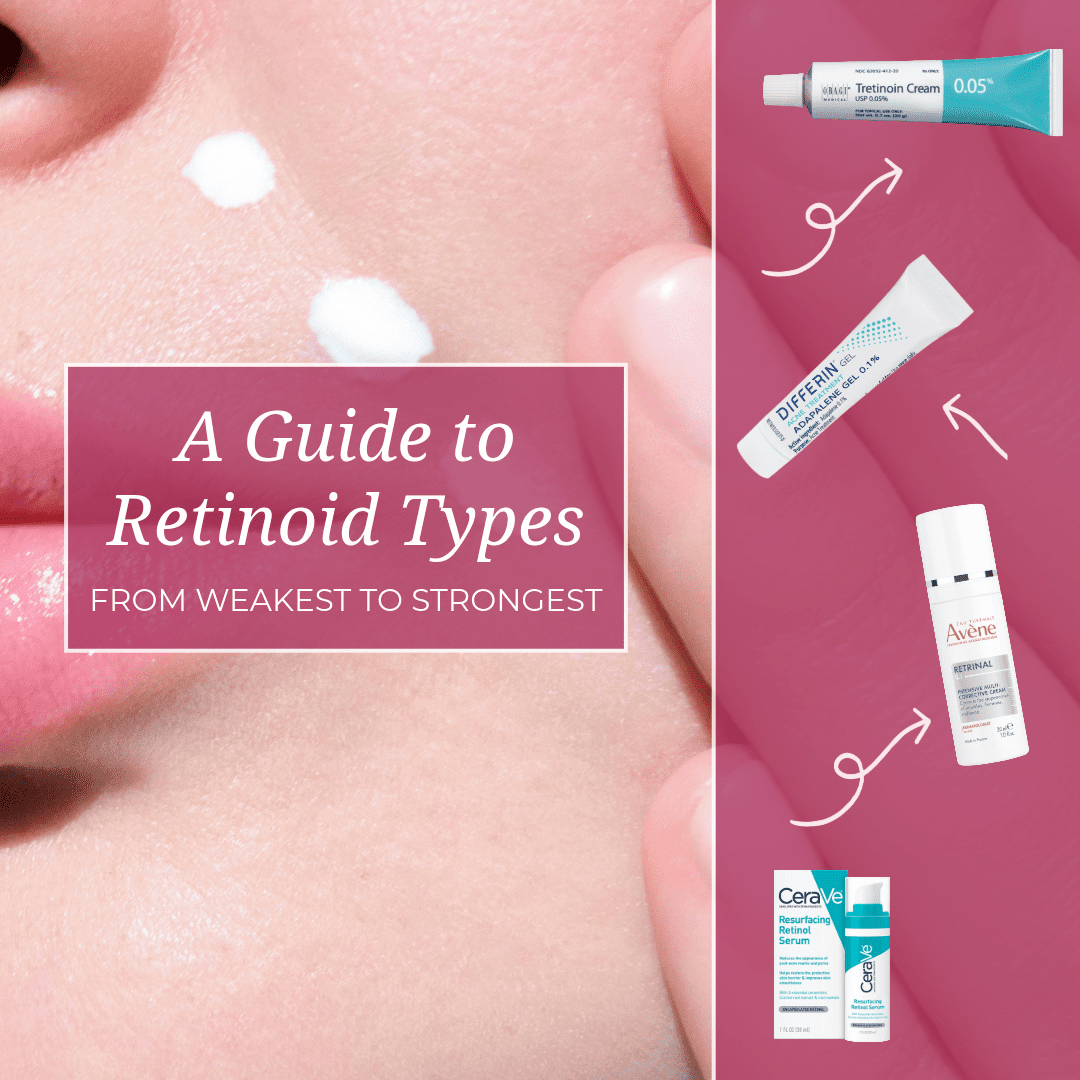
A Guide to Retinoid Types | From Weakest to Strongest
Between “retinol,” “retinal,” and “retinoid”, it’s easy to get confused. Let’s break down the four main categories of retinoids so you can finally understand which one is right for your skin.
There are four main types of retinoids available:
- Retinol: Over-the-counter, needs to convert twice in your skin
- Retinal: Over-the-counter, needs to convert once in your skin
- Over-The-Counter Prescription Strength: Like Differin, no conversion needed
- Prescription Only: Like Tretinoin, the strongest option
The key difference between these four categories is how many steps it takes for them to become active in your skin. Fewer conversion steps means faster and stronger results, but also more potential for irritation.
Category 1: Retinol
Retinol, spelled with an “o”, is what you’ll find at drugstores, Sephora, and most skincare counters. It’s the most common and beginner-friendly option for good reason.
How Retinol Works: Your skin has to convert retinol twice before it becomes retinoic acid, the active form that actually improves your skin. This double conversion makes it slower-acting but also much gentler on your skin.
Available Strengths:
- 0.1% to 0.3% – Beginner strength
- 0.5% – Intermediate strength
- 1% – Maximum over-the-counter strength
Best For:
- Complete beginners to retinoids
- Sensitive or dry skin types
- Anti-aging prevention
- Anyone wanting a gentle introduction
Results Timeline: Expect to wait 12-16 weeks before seeing noticeable results.
Example Products: SkinMedica’s Retinol Complex, La Roche-Posay Retinol B3, The Ordinary Retinol, CeraVe Resurfacing Retinol Serum, RoC Retinol Correxion
Category 2: Retinal/Retinaldehyde
Retinal, spelled with an “a” and also called retinaldehyde, is newer but quickly becoming a favorite among skincare enthusiasts.
How RetinAL Works: Retinal only needs to convert once in your skin before becoming active retinoic acid. This single conversion means it works much faster than retinol. Studies suggest it can be up to 11 times more effective than retinol at the same concentration.
Available Strengths: 0.05% to 0.1%
Best For:
- People who’ve already used retinol successfully
- Anyone wanting faster results without a prescription
- The middle ground between over-the-counter retinol and prescription strength
Results Timeline: You might see improvements in 6-8 weeks instead of 12-16.
Example Products: Avène Retrinal Intensive Multi-Corrective Cream, Avène Retrinal Advanced Correcting Serum, Geek & Gorgeous A-Game, Medik8 Crystal Retinal,
Category 3: Over-The-Counter Prescription Strength
These retinoids used to require a prescription but are now available over-the-counter. The most common is Adapalene, sold under the brand name Differin.
How OTC Retinoids Work: Adapalene is already in its active form, no conversion needed. Your skin can use it immediately, which is why it works faster than retinol.
Available Strength: 0.1% over-the-counter (0.3% requires prescription)
Best For:
- Acne and clogged pores specifically
- People who want retinoid strength without seeing a doctor
- Anyone who wants to level-up the results they’re seeing from their current retinol or retrinal
Results Timeline: Expect to see improvements in 8-12 weeks, particularly for acne.
Key Difference: This is technically a retinoid, not a retinol. It’s chemically different and works differently in your skin. Adapalene is particularly effective at unclogging pores and reducing inflammation, making it especially popular for acne treatment.
Example Products: Differin Gel, La Roche-Posay Effaclar Adapalene Gel
Category 4: Prescription Only Retinoids
Prescription retinoids are the strongest options available and require a doctor’s prescription for good reason.
Main Types
Tretinoin (Retin-A):
- Available in 0.025%, 0.05%, 0.1%
- Pure retinoic acid that works immediately
- Most studied and proven effective
Adapalene 0.3% (Prescription-strength Differin):
- Three times stronger than OTC version
- Used for moderate to severe acne
Tazarotene
- Available in 0.05% and 0.1%
- Incredibly effective but can cause the most irritation
How Prescription Retinoids Work: These are pure retinoic acid or active retinoids. No conversion needed, they get to work immediately in your skin.
Best For:
- Stubborn acne that hasn’t responded to OTC treatments
- Significant sun damage or deep wrinkles
- When over-the-counter options haven’t worked after 3-4 months
- Anyone wanting the fastest, most dramatic results
Results Timeline: You may see improvements in as little as 4-8 weeks.
Key Differences:
- Much more potent than anything over-the-counter
- Can cause more irritation initially (dryness, redness, peeling)
- Shows results faster
- Requires monitoring by a dermatologist
- Often more affordable with insurance
The Key Differences at a Glance
| Type | Conversions Needed | Speed | Strength | Availability |
|---|---|---|---|---|
| Retinol | 2 conversions | Slowest | Gentlest | Drugstore/Online |
| Retinal | 1 conversion | Faster | Moderate | Drugstore/Online |
| OTC Retinoids | 0 conversions | Fast | Strong | Drugstore/Online |
| Prescription | 0 conversions | Fastest | Strongest | Doctor required |
The fewer conversion steps required, the faster and stronger the results, but also the higher the potential for irritation.
Which One is Right for You?
Try Retinol if:
- You’re brand new to retinoids
- You have sensitive, dry, or reactive skin
- You want gentle anti-aging prevention
- You’re nervous about irritation
- You prefer starting slow and building up
Choose Retinal if:
- You’ve successfully used retinol before
- You want faster results without seeing a doctor
- You’re looking for a middle-ground option
- You’re impatient with retinol’s slow timeline
- You want to try something newer and more advanced
Try Over-the-Counter Retinoids if:
- You’re primarily dealing with acne
- You want stronger results without a prescription
- Retinol hasn’t worked well for you after several months
- You need something that targets clogged pores
- You want proven acne treatment without the doctor visit
Choose Prescription Retinoids if:
- You have severe acne or significant sun damage
- OTC options haven’t worked after 3-4 months of consistent use
- You want the fastest, most dramatic results
- You’re willing to deal with more initial irritation
- You have access to a dermatologist
- You want the most researched and proven option
Important Tips for All Retinoid Users
Regardless of which category you choose, follow these essential guidelines:
- Start Low and Slow: Begin with the lowest strength available in your chosen category. Use it 2-3 times per week initially, then gradually increase frequency as your skin adjusts.
- Be Patient: Don’t expect overnight results. Even prescription retinoids take several weeks to show improvements. OTC retinol can take 12-16 weeks. Stick with it.
- Always Wear Sunscreen: All retinoids increase sun sensitivity. Daily SPF 30 or higher is non-negotiable.
- Expect Some Adjustment: Mild dryness, flaking, or redness in the first few weeks is normal with any retinoid. This is often called the “retinization” period. It usually improves after 2-4 weeks.
- Don’t Use If Pregnant: Retinoids are not safe during pregnancy or breastfeeding. Talk to your doctor about safe alternatives.
- Apply to Dry Skin: Wait a few minutes after cleansing before applying your retinoid. This minimizes irritation.
- Less Is More: A pea-sized amount is enough for your entire face. More product doesn’t mean better results.
The “best” retinoid isn’t necessarily the strongest one – it’s the one you’ll actually use consistently without excessive irritation. A gentler retinoid you use every night is infinitely better than a strong prescription retinoid that sits unused in your cabinet because it irritates your skin too much. Don’t obsess over finding the “perfect” retinoid. Just start somewhere appropriate for your experience level and stick with it. Consistency beats strength every single time. Your skin will thank you for taking the gentle, patient approach, even if it takes a little longer to see results.