
SPF Head to Toe: A Dermatologist’s Guide to Body Sunscreen | As Seen in InStyle
Most of us have mastered the face SPF routine, but the neck, chest, hands, and arms are just as vulnerable to sun damage and skin cancer as the face. Dr. Mona Foad, featured in InStyle, shares her expert guidance on daily body sunscreen, including how much SPF you actually need, the most common application mistakes people make, and which body sunscreens are worth your money. Whether you’re looking for an everyday formula or something built for a full day in the sun, here’s what to know before you buy.
Should we wear body sunscreen every day?
Yes, if parts of the body are exposed daily, sunscreen there matters too. People tend to be consistent about applying sunscreen to the face, which is great. But, areas like the neck, chest, ears, hands, and arms are often exposed to UV rays on a regular basis. For the average person, I would say daily body sunscreen is most important on the areas that are routinely uncovered. You don’t need to apply body sunscreen every single day if most of your body is covered by clothing. But, any exposed skin deserves the same attention we give the face. In that sense, it is absolutely an important part of a daily routine, not only for preventing premature aging, but also for helping reduce the risk of skin cancer.
How much SPF and what PA rating would you recommend for daily wear?
For daily wear, I generally recommend using a broad-spectrum sunscreen with at least SPF 30. That level provides good everyday protection for most people when applied properly. If you are spending extended time outdoors, such as at the beach, a music festival, or any event where you are in direct sunlight for hours, I would suggest SPF 50 or higher, and more importantly, make sure to reapply every 2-3 hours since the protective effect wears off over that time.
When it comes to PA rating, which reflects UVA protection, I recommend choosing PA+++ or higher. Especially for people concerned about hyperpigmentation, melasma, or photoaging. UVA rays contribute significantly to long-term skin damage and can pass through clouds and windows, including your car window. The most important thing is not just the number on the label, but also making sure the sunscreen is broad-spectrum and water-resistant when needed. I always prefer to have a sunscreen with zinc oxide as an ingredient because zinc oxide is the best at covering both UVB and UVA rays. Also, always remember, UVB rays are what we call Burning rays, while UVA are what we call Aging rays because they go deeper in the skin and can cause more long term damage.
Do you have any tips for sunscreen application?
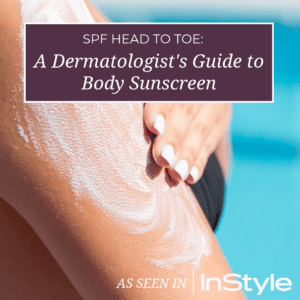
One of the biggest issues I see is that people don’t apply enough sunscreen and don’t re-appply. For the face alone, a helpful guideline is about two finger lengths of product, and for the body, most adults need about one ounce, roughly a shot-glass amount, to fully cover exposed skin. It is also important to apply sunscreen before sun exposure rather than after you are already outside, and to remember commonly missed areas like the ears, neck, chest, scalp part, tops of the feet, and backs of the hands.
If you are spending time outdoors, sunscreen should be reapplied every two hours, and sooner if you are swimming or sweating. I also remind patients that sunscreen works best as part of a broader sun-protection strategy. Hats, sunglasses, protective clothing, and seeking shade when possible all add meaningful protection. Sunscreen is essential, but it should not be the only measure you rely on.
What are some of your recommendations?
Supergoop Unseen Sunscreen Body – This stands out for its lightweight, invisible finish, which can make daily body sunscreen feel more wearable, especially for people who dislike heavier or greasy formulas.
La Roche Posay Anthelios Melt-In Milk Sunscreen – This is a sunscreen I generally view very favorably. La Roche-Posay tends to do an excellent job with formulations for sensitive skin. This one offers broad-spectrum protection and has a moisturizing feel. It is a good choice for daily wear, especially for those with drier or more reactive skin.
Elta MD UV Sport Sunscreen Lotion – EltaMD is a brand many dermatologists trust. This is a solid choice for people who are active or outdoors for long periods. It offers higher SPF protection and is designed to hold up well with sweat and activity. It is practical, dependable, and well-suited for sports or long outdoor days.
Cerave Hydrating Mineral Sunscreen SPF 50 – This can be a good choice for someone who prefers a mineral sunscreen, especially if they have sensitive skin. CeraVe products often include ingredients that support the skin barrier. That can be helpful for skin that is easily irritated. The downside is that mineral formulas can sometimes feel heavier and may leave a visible cast, depending on skin tone.
Blue Lizard Sensitive Mineral SPF 50 Sunscreen Lotion – This is a good option for sensitive skin, especially for people who prefer mineral sunscreens. It is straightforward, gentle, and less likely to irritate reactive skin. Like many mineral formulas, though, it can feel thicker and may leave a white cast on some skin tones. It is a strong choice for skin sensitivity, but the finish may not appeal to everyone.